Questions and Answers on Worldbuilding,
1 - What parts of the civilisation do you want to focus on the most? What aspects will be most useful/interesting to you? I focus mostly on the background social organisation and economic/bureaucratic arrangements this society uses to ensure its war fighting can continue. The are strongly implied to be constantly at war but rarely do I depict that. I am very much interested in the day to day civilian life of a chaos worshiping society in the 40k setting.
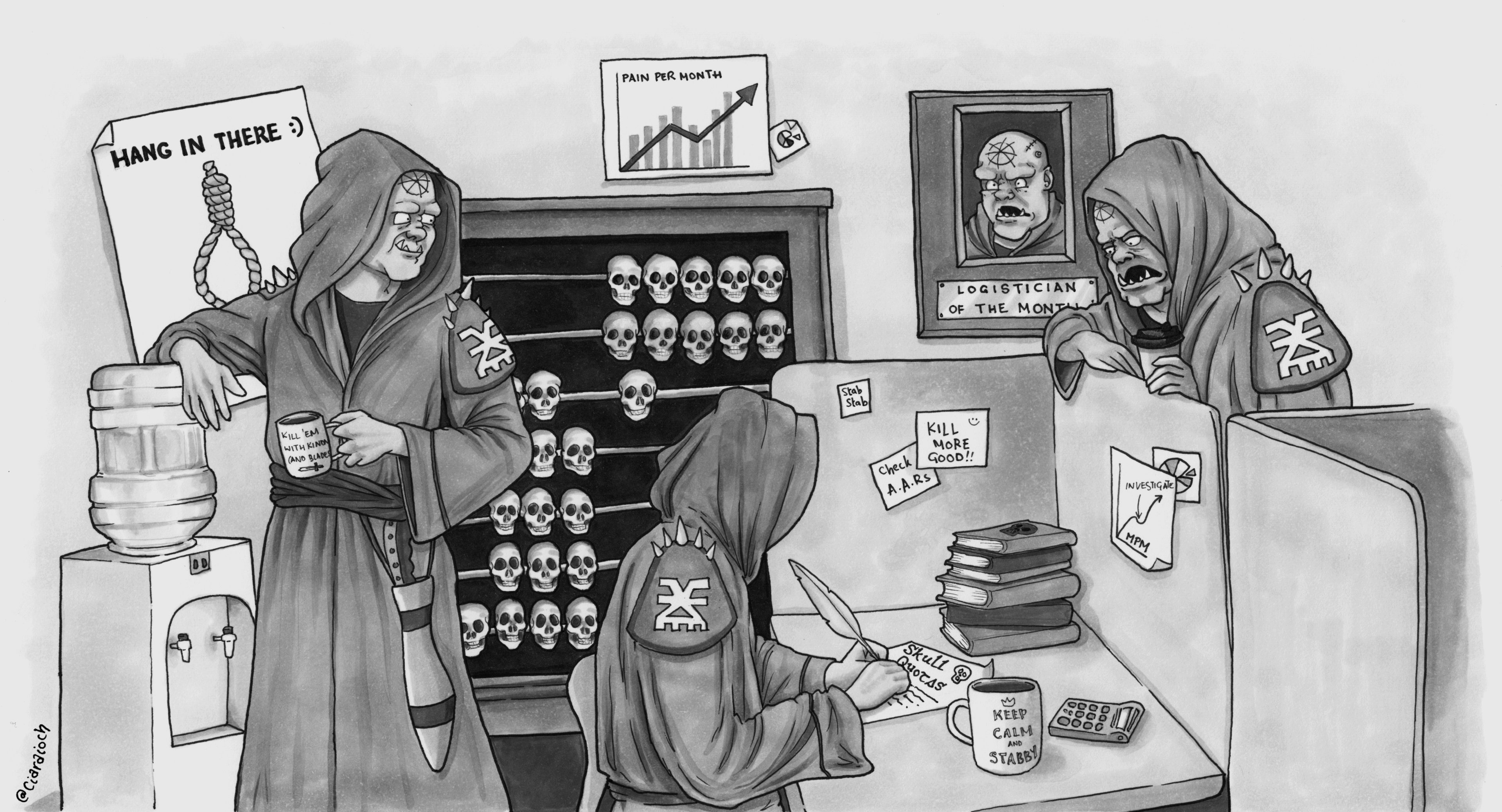
2 - Which aspects do you want to focus on the least/don't need at all? Warhammer fans often focus a lot on weapons specs and armour classes. I’m uninterested in this. I also rarely write combat scenes. This is not actually because I am uninterested in this: well-written action is something I really enjoy. I just happen to be bad at it, and I get too embarrassed to share work wherein I try. Which is odd because it feels like once one is maintaining an elaborate 40k fanlore site one has pretty much hit rock bottom in terms of how cringe you can be, and so I should have nothing left to fear? Yet, so it goes.
3 - If I ask some random neighbour of this civilisation, what are they likely to tell me about it? How might they explain what that civilisation is in couple sentences from their layman's perspective, and what do they think about it? Terrifying mass murderers dedicated to a blasphemous god of war and madness. Overwhelmingly what would stand out about them is how relentlessly aggressive and expansionist they are. Of course, the 40k setting being what it is, I presume plenty would be kept ignorant of them by the powers that be. But in a couple of cases (Mot, Enlil) they are actively at war right now. And others (Kur) it’s an open secret they are funding insurgencies. If anyone gets to know them a bit more this will still probably be the dominant thing that stands out about them, albeit if a person has familiarity with Khornite religion they might find the emphasis on efficiency and logistical calculation noteworthy. (Though if this website has done its job then I hope they will eventually reflect that it is odd that there are not more war-god-worshiping-societies that are logistics focussed, when you think about it!) So, where people do know of them, it’s because the Sanguinary Utnapishtim are known as the cause of war and misery — which is just how they would want it!
(One guest author actually wrote a short report summarising the Sanguinary Utnapishtim's schtick from the perspective of some outsiders. Specifically, some Word Bearers. So here you're seeing a rival chaotic point of view. Check it out!)
4 - If I visit that civilisation as a tourist and explore around a little, what would I see? What do you think would capture my attention the most? Heavily regulated trade spots would be all you would be officially allowed to witness, which would mostly look like functional utilitarian military posts staffed by scowling soldiers. Something like I imagine the experience of visiting the DMZ checkpoints along the border between North and South Korea. If you could slip away it would be to an under-hive on one of the conquered worlds, for instance Ashnan, wherein the experience would be… well, an under-hive.
5 - How would they react to such a tourist by the way? And what's their opinion on outsiders in general? How much do they know about the outside world to begin with? Utterly hostile. At least, official sources would be. Their state is fundamentally paranoid and they would assume this is a subversive agent here to undermine them. They are very aware of the outside galaxy; so it is not that they are unaware that some people from elsewhere might claim just to be curious or have an adventurous spirit. It’s just they interpret this through the lens of their ideology of constant warfare and attempts by the inferior to undermine the Mighty, and so hate it with a burning passion.
This, at least would be the reaction of the state and official institutional sources. In fact, most of the population of the Sanguinary Utnapishtim are slaves. They would perhaps welcome the variety, perhaps enjoy the experience of doing something subversive in welcoming the tourist precisely because they know their hated masters would be suspicious of this. In some cases, of course, the slaves would buy into the ideology and react like the official sources say they ought. But I imagine this is a minority of cases, most slaves are not in fact sold on the governing ideology that has them as lesser.
(There is also the case of: internal tourism within the Sanguinary Utnapishtim, say visiting one planet from another. I do not think their economy would really permit much of this, so the vast majority of people would not leave the planet they are born on. Those that do will mostly be Mighty and travelling for official Church or State business.)
6 - What environment is the civilisation in, be it some natural climate/biome or anything else? How does it affect it's members, both on large scale and in their daily life?. Incredibly varied: I maintain for my personal lore document a list of 57 separate habitats they live in. That said, hive planets are so huge in their population that the median person is a hive dweller.
7 - What kind of creatures will I likely encounter, whether wild, domesticated, engineered or anything else? Likewise incredibly varied.
8 - Is their culture mostly homogeneous, or does it vary a lot? If there are any sub-cultures, write one sentence on several of them. The Sanguinary Utnapishtim is a small enough Empire that there is some genuine shared culture. This is provided by the fact that around 25% of the population are of the Sherden Pact, the military, and are themselves spread throughout the Empire and on its various campaigns. They go through shared education and training, are familiar with the same military bureaucracy. What’s more they all have a shared religion, the worship of Khorne as regulated by the Church of the Burning Massacre, taught through shared rituals and texts creating the basis of artistic and literary culture, and preached by its Paters. The latter also administer some sort of Trial at a young age to determine whether or not one is Mighty; this too is thus a shared cultural constant, and it is very common to make a muchness of certain religiously significant events. In particular, a child’s First Murder is usually celebrated, and when or how it occurs is seen as a good portend for whether or not the child will turn out to be Mighty.
However, there are multiple different planetary systems with many different habitable bodies therein. At least one other significant population of non humans (loxatl) exist within the Empire. What’s more, while wardum (the majority of the population) are required to be in the Church and are monitored closely for signs of disloyalty, in other ways they are far more culturally free since the higher ups basically don’t think their culture could ever amount to much anyway. All in all, then, there are a great many sources of sub-cultural variation within the Sanguinary Utnapishtim.
As for some examples of sub-cultural groups which I have paid some attention to:
Sanguinary Utnapishtim Mainstream - it’s actually a bit unusual for a 40k setting that there is a shared mainstream pop-culture that gets any attention. But in the Sanguinary Utnapishtim there is an official Office for the Propagation of Pertinent Information and a shared Church, both of whom in their own way spread cultural artefacts that homogenise things somewhat. Both myself and guest authors have been drawn to write on this fairly frequently, meaning this is thus a society with a recognisable shared pop-culture. Features of their shared entertainment culture I have depicted so far are logistical-management simulation games, fight-clubs, gladiatorial arenas, and action-adventure snuff-films. It’s a Khornite culture, what can I say. Also, while I have tended to depict these people as somewhat prudish, they do have dating, marriage, and sex-lives too. The state’s attempts to regulate the latter have been known to cause problems, in fact.
Erudites - for at least some of the officer cadre and logisticians I have tended to depict them as educated and erudite. While few live up to the ideal, in principle there is a kind of mixing of athleticism with both Snow’s two-cultures in this group, since what is considered culturally impressive would be a combination of ability to deploy violence, appreciation of Khornite religious texts, and proficiency with statistical reasoning. Since promotion is species-blind and by merit not birth, there is a sense in which they are often more egalitarian than is normal for the Imperium cultures they conquer, which can cause conflict even after the war of conquest is over. Don’t be fooled by their manners: they are typically blood-thirsty imperialist war-mongers.
Warriors of the Qarnu Anšar - a bunch of fucking manchildren. Khornite renegade astartes, and thus functionally immortal and with super strength. There are not many of them left alive, and they are unable to work the technology necessary to reproduce themselves, making them in fact entirely dependent on the Sherden Pact.
Loxatl (main brood) - the most numerous within the bounds of the Sanguinary Utnapishtim, they have for some time been integrated into empire. Technically their main grouping is one very very large family unit, known as a “brood”. For reasons related to the models I like depicting them with on the tabletop, this brood has developed the rather strange habit of walking on their hindlegs, deeply strange for a largely quadruped species. They are a rather laconic and cynical culture which sees itself as having a good thing going-on, since they surrounded by all these enthusiastic humans who provide them with regular opportunities to hunt and some degree of social standing and respect. So they are not inclined to rock the boat, but also keep themselves somewhat apart from the human mainstream and fiercely protect that independence.
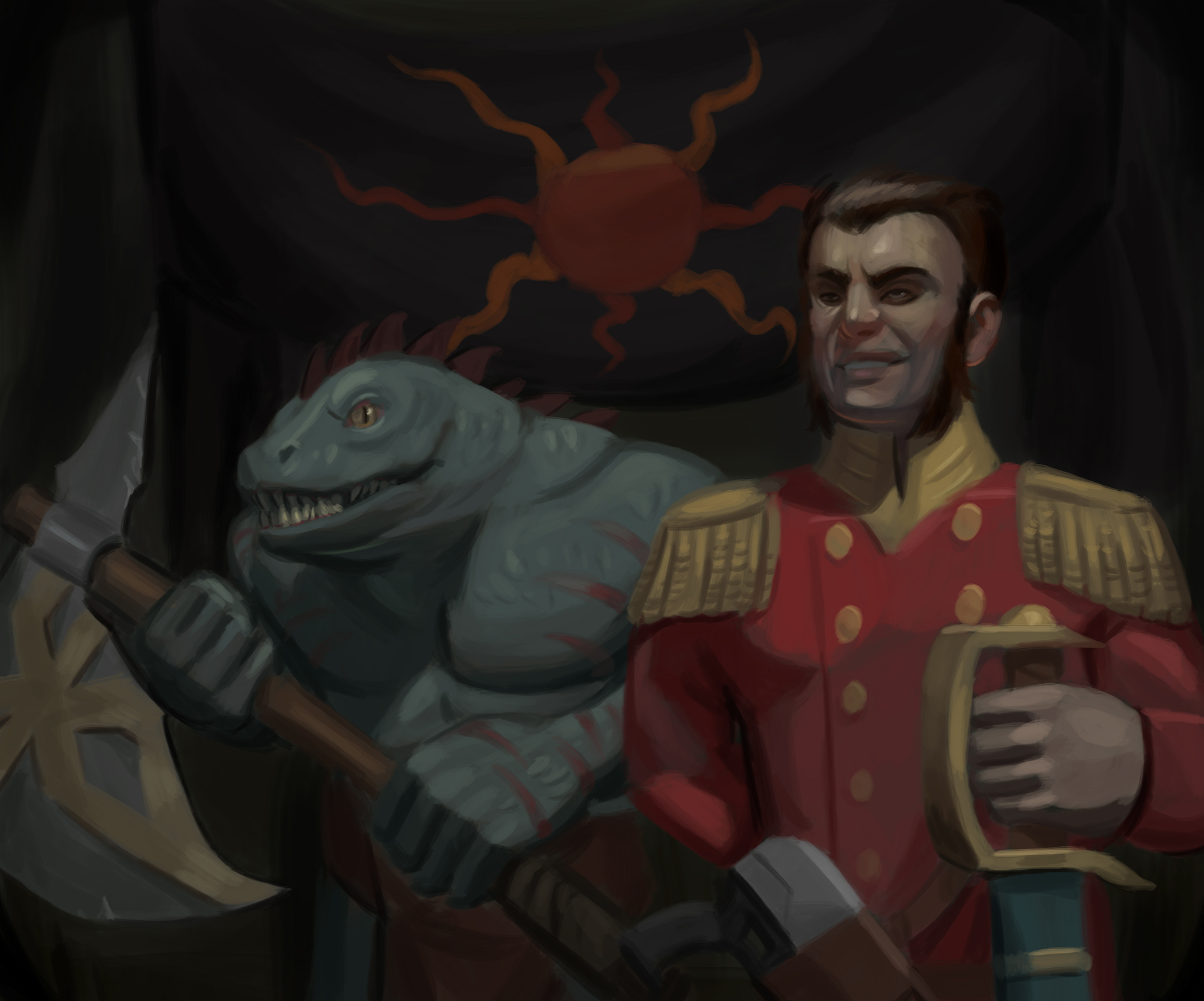
The above four are distinctive sub-cultures that have all featured in one way or another in stories so far. Whereas the below two ones I have had in mind but not yet had a chance to do anything with.
Merchant Navy - one of the few means of enjoying some degree of autonomy in the paranoid and authoritarian Sanguinary Utnapishtim is to find one’s way into the merchant navy and act as a trader, meaning these jobs overwhelmingly attract and develop the most free spirited and borderline blasphemous people in the Empire. (This could be an interesting means of exploring an empowered dissident-but-not-all-the-way-seditious group within the Sanguinary Utnapishtim, which It think could make for interesting depictions of cultural adaptation to living amidst Khornites without succumbing to the madness and evil.)
Shara Tribal - there is a planet therein with something like a stereotyped picture of 17th century Scottish highlands culture… In Space! They are aware of the broader technical wonders they live amongst but are uninterested. Rarely enthusiastic Khorne worshipers but not hostile to it either. Their base culture is violent enough to be tolerated by the Church as not in urgent need of proselytisation - but of course some missionaries disagree and are known to disappear into the hills. (I have in mind here something like the culture John the Savage is from in Brave New World, wherein it is tacitly tolerated as it is seen as an acceptable release valve for social tensions by the otherwise very controlling state.)
9 - How united are they politically, if at all, from single centralized state to a coalition to a civil war ongoing? The Sanguinary Utnapishtim has a unified and fairly strong central state under the Etogaur. By the standards of 40k (incredibly important qualifier!) they are actually a competently organised central bureaucracy that coordinates across their relatively-small but still genuinely interstellar empire.
That said, there is a strong Church that has a friendly-but-not-entirely-aligned-with-the-state relationship to central power. The loxatl have their own organisational structure, wherein its a bit of a polite fiction that they are subservient to the Etogaur. With the Qarnu Anšar on the other hand people maintain a polite fiction that they are not subservient. Numerous anti-Khornite rebel groups fester within. Cults dedicated to Slaanesh and Tzeentch abound. Imperium loyalist sympathies survive throughout, due to persistent secret worship of the Emperor. More secular political wardum resistance movements grow, as they are being armed and coordinated by both xenos infiltrators and Alpha Legionnaires under Lord Shang.
10 - How would you quickly and simply describe the political system/systems in place? How is that system doing, and how popular is it there? The Sanguinary Utnapishtim is a highly centralised military dictatorship run on a war-communist economy, with a large slave-caste. It is legitimate enough to be stable but not really popular.
11 - What is the hierarchy of this civilisation? How much power do those higher up have compared to those beneath, and how great is the social mobility between the levels? There is a big divide between Mighty and wardum populations. The Mighty are the ruling class, favoured by Khorne - and compose just over a quarter of the population in total. The wardum are everyone else, natural slaves of the Mighty, per the governing ideology. You are sorted into your respective class at a young age if you are born onto a Pact held world, or as soon as they can get round to running Trials in your area if you are on a conquered world. Status is not meant to be hereditary but de facto families tend to ensure their children are Mighty if they are. And, alternately, if a child of a wardum is found to be Mighty they are immediately cut off from their old ties so it is not really a means for the family itself to advance socially to place their child well. The Mighty have despotic power as a corporate body over the wardum. However, at an individual level it can vary. The Mighty, certainly the humans among them, are (almost but not quite) entirely divided into one of two organisations. The military, known as the Sherden Pact, or the paterite, known as the Church of the Burning Massacre. Each has an elaborate system of ranks, although the two ranking systems are incommensurable. The military is larger and predominates over the paterite, but of course soft power is a thing (much though everyone would be loathe to admit it in the Sanguinary Utnapishtim) and its hard to say just how much power a popular but low-ranked Pater really has.
In principle everything is organised by a top down 8 Year Plan set out by logisticians (who are themselves technically part of the military) on Uruk, the capital world of the Sanguinary Utnapishtim. But in practice everyone at every level has some degree of discretion and it is not as neatly organised as its ideologues would have you believe. Anyone of any rank - so long as both are Mighty - can challenge anyone at any time to a Trial By Might, or a duel, to settle disputes. These will typically be granted, but there is an institution called Hostile Rencounteurs whose job is to ensure that Plan-Vital personnel are not killed off.
Wardum may never ever challenge Mighty to a duel, but anyone blaspheming against Khorne can always be struck down immediately by anyone, and it can be grounds for manumission if a wardum is the one to do so. Mighty need not ever challenge wardum to a duel and can simply kill them at will, but if they kill a Plan-Vital wardum they can expect severe punishment in turn. So discretion is called for even in violence against slaves. In fact, that latter speaks to how wardum can acquire some status in the Empire. It is possible to be well knownedly Plan-Vital, such that killing this person would be grounds for immediate execution itself. Social mobility for wardum (outside of rare cases of manumission) thus consists in working one’s way into a position whereby one is viewed as Plan-Vital. So one of the things the D.I.E. training even does is encourage people to treat such wardum with a modicum of social respect, which is considered very radical and shocking within the Sanguinary Utnapishtim.
12 - What are some religious/spiritual beliefs found there, and how widespread are they? How do these beliefs impact their daily life? The Church of the Burning Massacre is the only legally tolerated religion. It encourages a kind of channelling of Khornite energy into productive (read as: murder maximising) collective activity. As mentioned, there are a number of heretics they have thus far failed to stamp down. That said, most people generally buy into broadly Khornite ideas, even if for obvious reasons the slave population tend to be more cynical about and wary of the whole thing. I think the nature of a society so steeped in warp-shenanigans as a chaos worshipping one would be is that everyone is at least a little bit crazy, making this whole maximise-the-murders thing seem far less silly and horrific to them than it actually is.
13 - Who are the most respected members of their society? What roles do they have? Charismatic preachers and superlatively skilful warriors, leaders, or logisticians, are the culture heroes. The Etogaur is presented in propaganda as something like all of these at once.
14 - How long has this civilisation been around, and what were their predecessors? (Does anyone even know?) Subjectively as they measure time they think the Sanguinary Utnapishtim has been around for a few centuries, but their own origins are murky to them. Further they trace some connection to the Consanguinity in the Sabbat sector; if that is correct then they are in some sense millennia old as a society. The region they now wage war in was Imperium space before the opening of the Great Rift, and Necron space long before that. One of the nearby plants (Displanit) is in fact a Tomb world on which an awakening is taking place, but they are unaware of that fact, distracted as they are by the Ork invasion there happening and the opportunities for violence such a thing presents.
15 - How much have they changed since their beginning? And are there any major changes in technology, culture, politics or anything else happening right now? The Sanguinary Utnapishtim is unusual in the 40k setting for being a genuinely progressive Empire, though of course not to the same speed or scale as the Tau. But they are expanding territorially, going from being really just the possessors of the world of Uruk and its environs to being a multi-systemic empire. They are far wealthier than they were, not just in raw produce but in per capita terms too, as they are capable of making technological and methodological innovations and spreading them to where they would do most good. Their ideology has also developed, coming to accept xenos where once they did not, and also refining their ritual forms to make the more bureaucratic and rationalised place we see today.
Basically one of the things I wanted to do with this little setting was introduce the idea of a group that is progressive in a bad way. The overwhelming emotional tone of the 40k setting is one of decay and loss - “forget the power of technology and science, for so much has been forgotten, never to be re-learned”, as the intro blurb has it. Part of how that expresses itself in most of the writing is that everyone is forever losing their ability to do stuff. The whole universe is winding itself down, one feels. Only the Tau buck that trend, and non-coincidentally they are also one of the relative sources of hope and optimism for the galaxy. But you can combine technical progress with overall pessimism! The Sanguinary Utnapishtim are getting richer and more technologically capable and that’s bad! They produce enough wealth and thereby improve living standards just enough to generate buy in and technical capability for a project of forever-war in the name of murder Satan. It’d be better if they were decaying, better if they were regressive as everyone else.
So, yes, I consider that a sort of unique-selling-point to this fanlore setting within the context of 40k. The Sanguinary Utnapishtim are a wealth-generating technologically progressive society, and this makes them worse not better.
16 - What modes of transportation do they use? Full range of typical 40k armour and void assets. Individual planets vary in their level of wealth, but public transport rather than personal motor vehicles is the norm. Motorbikes and vespas are common on mid-status worlds. If any artist has read this far and wants to draw someone commuting to work on a Khornite vespa I will love you forever.
17 - How fast and easy is communication over long distances? How does that affect how things work there? Transport and communication between worlds in 40k is always subject to vagaries of the warp. But the Sanguinary Utnapishtim’s major major advantage, and what has allowed them to expand as they have, is that on their side of the Great Rift it is much easier for worshipers of chaos to engage in long-distance travel/communication so long as they have the favour of their patron deity. Khorne still has time for the Sherden Pact, so they can do this while Imperium lackies and other xenos can travel/communicate only with great difficulty.
18 - What happens if someone is hurt or sick? Who handles it, and how? A military hospital system is available to the Mighty at all times. This is considerably better than would be standard in the Imperium, and since the Mighty are around a quarter of the population this ironically means the Sanguinary Utnapishtim has far better healthcare than was standard before they arrived on most worlds they have conquered. Some basic public health measures do exist for wardum too, since the spread of disease is religiously blasphemous since it may help Nurgle, and in any case impedes efficiency. But it’s not that good. That said, there is a reasonably large shadow economy in various traditional herbal cures, which range from totally ineffective to actually pretty good.
19 - Do they have anything that can automate at least some of their work? If yes, how much of their work is automated, and how? Since the Sanguinary Utnapishtim is not bound by the strictures of the Imperium with regard to anti-AI dogmas, they are actively experimenting with artificial intelligence to help automate stuff. To this end they have entered into a compact with Dark-Magos Mantasalm, who itself is a servant of Archmagos P’ymp-D’ahdee (pronounced Pea-Why-Imp Dar-Desh, as he will pointedly insist) and his syndicate. Early experiments in this regard have been on the whole productivity enhancing, not so much because they are that much better than a well trained logistician but because they reduce incidence of Tzeentch corruption as a byproduct of excess logistical work. The programme is thus being expanded beyond the pilot schemes that have been run so far.
Right now the big project is on work automating the advanced linear programming you need to do in order to calculate optimal solutions to various resource problems thrown up by the 8 Year Plan, or sub-elements thereof. Since this is quite a significant use of time and resources in the Empire wherever they are able to make progress on this it is a notable gain.
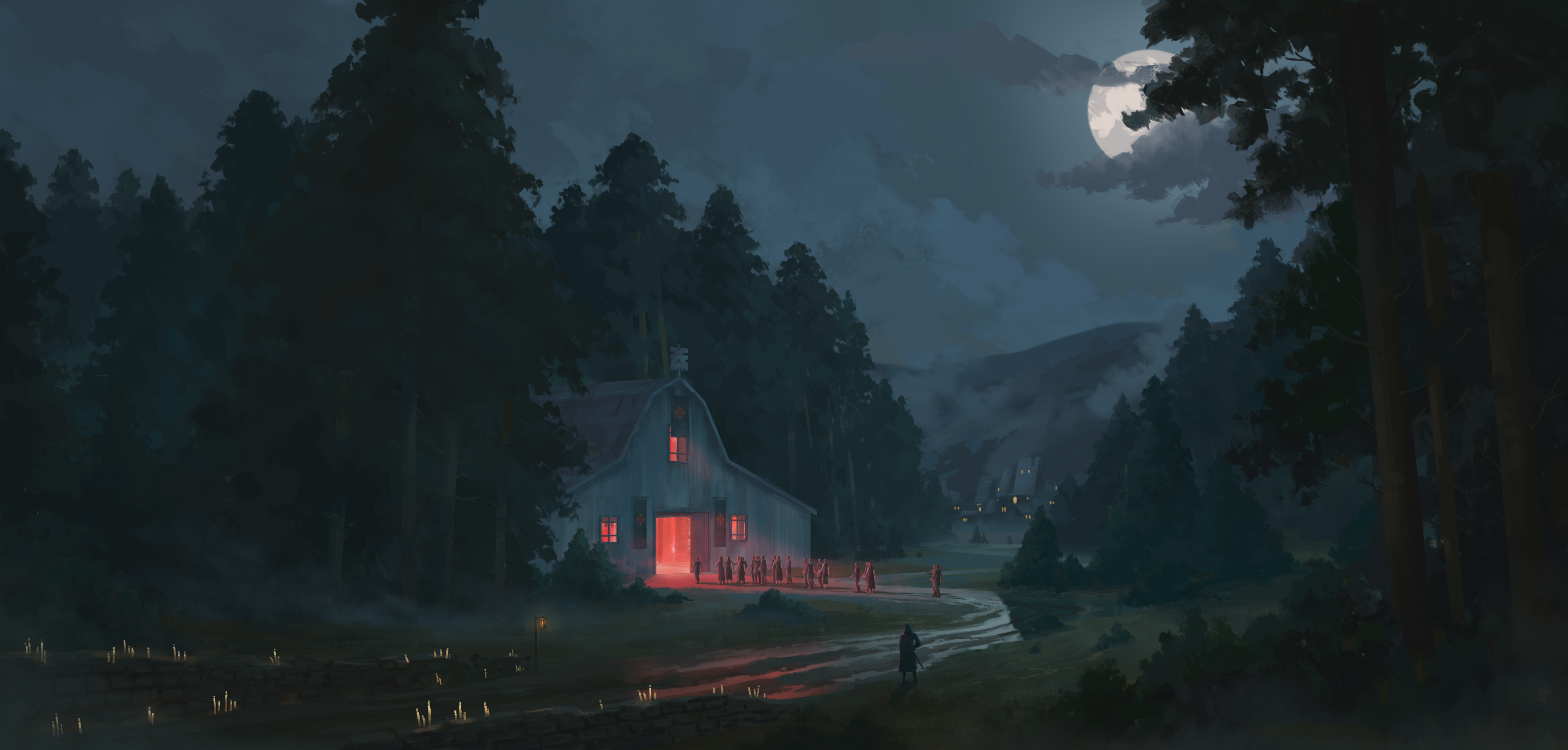
20 - What kind of structures have they built, and what purpose do those structures serve? Give me couple examples of something typical there, as well as an example of some more special structure or project if they have any. Standard architecture might include: the logistical bureau, usually a grey modernist building with some minimal Khornite adornments. Churches or temples vary a lot with the cultural conditions of the world they match in, with clear “high” and “low” church equivalents. Often teeming with baleful warp energies that the populace of course find invigorating (I think the artist did a good job of depicting below). Public transportation is a common mode of commuting, so there are lots of stations by which one could catch the train to work or what not. More spectacular structures are often public statues of heroes or martyrs.
They did not build it, but the most impressive artificial structure they have control over is the Mashu void station. Huge, warp capable, and well armed unto itself. Capturing and rendering operational this behemoth was what allowed them to project power beyond the Uruk system in the first place. In so far as there is a real person behind the myth of their heroic founder figure, Atrahasis; securing this station was no doubt his finest military achievement.
21 - Give at least 3 more examples of their technology/magic that fit into other categories (note: besides military, that will be asked about later) The first interesting bits of not-directly-military technosorcery they control are the temnet beacons. These are a series of deep void relays which render warp travel possible within any zone pacified by the Sherden Pact. They are a form of magitek and thus rely on both enginseer corp expertise and also regular infusions of ritual energy to keep empyrically empowered. They project pure beacons of hate and operate as fixed points for navigational purposes within the Sanguinary Utnapishtim. What is more, they amplify messages sent in anger. The major logistical significance of this is they allow void travel without a specialised navigator, and they greatly increase the range and reliability of long distance astropathic communications. They can even be modified to simply stop aiding and assisting interstellar travel but rather the opposite, essentially by “turning up the rage” such that anyone who tries to focus on them goes into a murder-rage rather than being able to navigate. What this means is that the Pact have significant ability to slow down warp travel within their zones for anyone who lacks their goremages’ tolerance for pure unbridled fuck-off anger all the time. They are hence also of strategic significance. Keeping these devices powered and attuned is the primary active use for the Office for Ceremonial Calculations’ generated ritual energies.
Next is Bārûm-gel, which features in this story. Occult symbolists working under the guidance of Kidinu Bārûm at the Taruoduron Academy realised that the semantic-metaphorical resonances between rage, fury, and violence on the one hand, and the internal operations of piston engines (working as they do by forcefully compressed energies given explosive output) on the other, meant that even devices without a machine spirit may still be improved by Khornite warp energies. This has allowed for development of a rage-treatment which, when applied, drastically reduces heat loss and friction losses or inefficiencies - by essentially reabsorbing and immediately redeploying back into their system physical energies that might otherwise dissipate. So far this has just led to relatively modest efficiency gains in the devices used, and incidents of the machines become sentient and murdering workers have been well within acceptable parameters.
Finally there is the aforementioned syndicate developed AI, which they sometimes know as the “Ekallatum-Device”. Of course, being a Khornite society anything they do will ultimately be at least a little bit military in application Witness, for instance, the Device featured in this story and what happens with it.
22 - what are some examples of what their technology/magic can certainly NOT do? Incredibly significant for them, their technology (both travel and communication) does not allow them to traverse the Great Rift. For whatever reason, whatever it is that lets other Chaos warbands do this, they cannot. So, while their logistics within Nihlus are better than the Imperium’s and most xenos, it is considered a great shame indeed that they are unable to make contact with the Consanguinity over in the Sabbat sector. Attempting to rectify this was the reason for their disastrous campaign on Mot.
23 - How much does average layman know about the technology/magic of their civilisation? The Mighty population is relatively educated and ideologically trained. Wardum varies greatly. No great secret is made of these things though so I presume in most places people would broadly aware of what’s up.
24 - What do the members of the society look like, including clothes and decorations? How varied is their look? They are very diverse ethnically, with a slight bias towards mid-brown quasi MENA look to them. And while species wise humanity dominates, there are enough xenos within the empire for it to be unremarkable if one is seen about. The most common of these are loxatl, who are lizardmen.
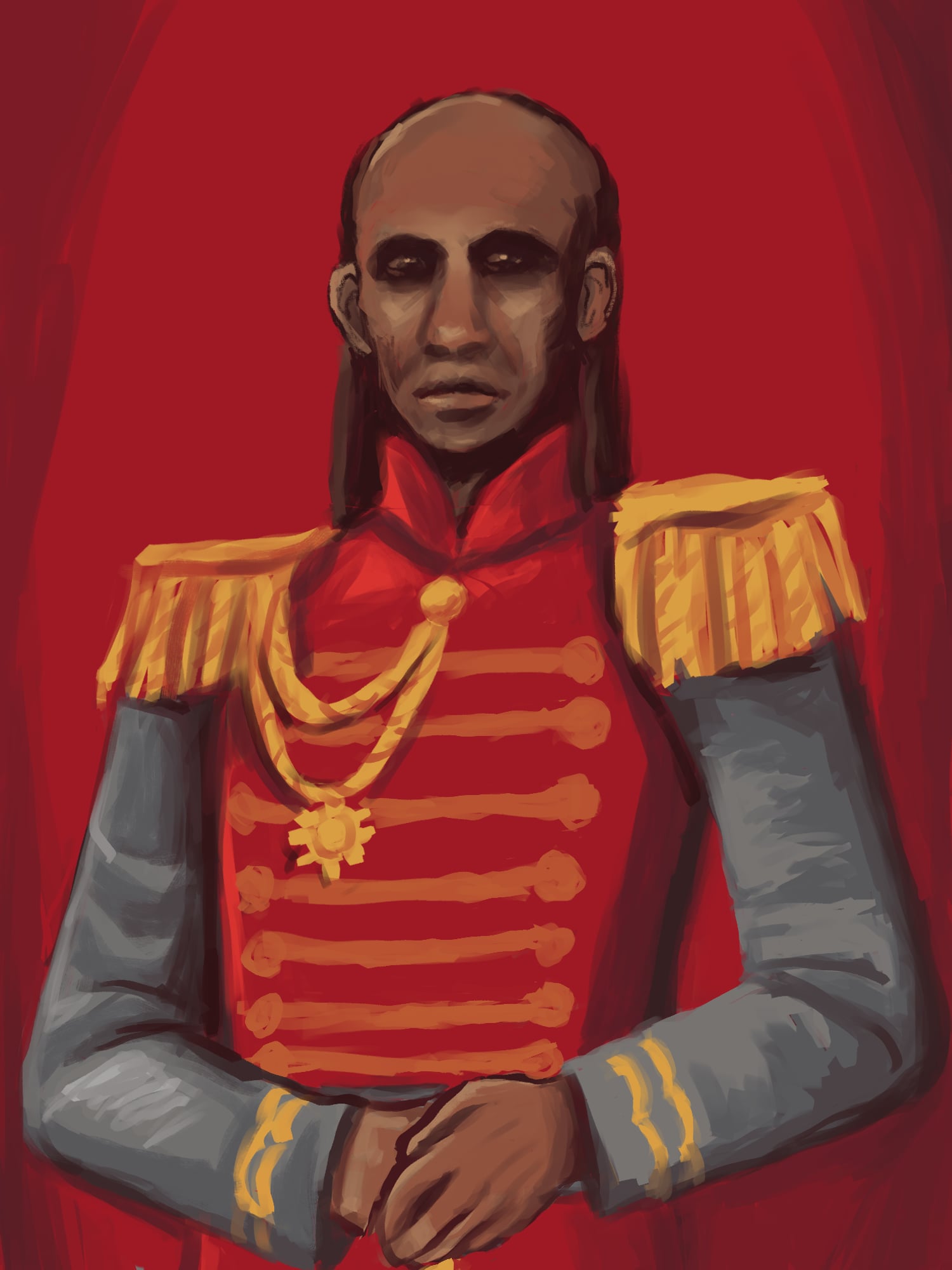
Clothing wise, I have said a bit on the fashion here. The military have a uniform, whose primary colours are red, orange, and black. Elements of gold are sometimes incorporated to denote rank. They look like a modern military in some regards, other than the garish patterns. A very high proportion of their society are in uniform a very high proportion of the time, so compared to a contemporary wealthy society the people here would look remarkably similar to one another.
Civilian wear and Church wear is more often robe-esque, somewhat akin to a medieval scribe in its plainer form, and Assyrian nobility in its more fancy forms. Religiously the colours blue, teal, and yellow, all feature more, denoting various sacred symbols to their cult. That said, this is a point where I am thinking a lot about it nowadays and expect to develop my worldbuilding a fair bit in the year to come.
25 - Is there any equivalent of a high quality dress or suit one would wear to some special occasion? If yes, what is it, and why does it look the way it looks? There is a dress uniform for the military, which would be the most typical formal wear. See the portrait of Gal-Uru below . There is also civilian finery as described above. I think it’s fairly obvious why the formal fancy wear of a Khornite society would look military.
26 - What does the architectural style/styles look like? As described above. They are often inheriting the architecture of conquered societies. But where they build their own think a somewhat science-fictional mid-20th century modernist, brutalist and drab. They are not in the main a society of great artists.
27 - How would you describe the general aesthetics of this civilisation in 5 words? Brutalist, militaristic, functional, ominous, baleful.
28 - Do they have any typical foods or drinks worth mentioning? Shara-grox is a delicacy meat dish, but only the upper echelons of their society would have access to it beyond residents of Shara itself.
29 - How do jobs and employment work (assuming they do that or something similar)? Jobs are assigned by a planning ministry. But a large shadow economy exists which works along basically market principles, and is indeed tolerated tacitly since it corrects known inefficiencies.
30 - Do they use currency? If not, what do they do instead? Yes, although this was something of a scandal at first. The have ration-scrip which was meant to just be a token one hands in for assigned goods but has de facto become a paper-currency now. This is tolerated by planners as useful, but some hardliners on Uruk wish to revert to the previous more pure central planning with minimal barter economy to make up the rest.
31 - What's some of the most important work to do that really keeps the society running? There's probably a lot but give me just couple examples, let's say 3. Agriculture, largely carried out by slaves. Military work, the province of the Mighty. Logistical work, carried out by both wardum and Mighty.
32 - how do they relax and spend their free time? Officially the answer is prayer and meditation upon the teachings of the Church. But unofficially, see the mainstream culture mentioned in response question 8. In addition to such things, there are of course the normal petty forms of social competition like gossip and what not.
33 - Describe an average day of an average member of this civilisation (You can describe the average day of some other kinds of members as well if you want to) The modal person is a slave. They live in a fairly unregulated part of a hive (cos of the population structure of hives the modal person also lives in a hive) and commute to some sort of manufactora or logistical job. They work 7 days out of an 8 day week, with staggered rest days being allotted because it has been deemed more efficient that way. (Also the staggering of the rest days is designed to ensure that not too many wardum are all off work in the same place at the same time.) They have enough education to carry out that job so may be literate; this is at least not unusual. If so, they probably read the daily bulletins from the Office for Propagation of Pertinent Information on their way to work. Transport will be overcrowded and uncomfortable but tolerably reliable - albeit deliberately rendered justbroken enough to induce constant holy commuter-rage without preventing the day’s tasks actually getting done.
When they get to work they will be subject to constant monitoring, and liable to be beaten or worse if their performance is judged unworthy. Those who frequently incur infraction beatings tend to be selected for sacrifice in public religious rituals. So they will work hard, at least so far as the person monitoring them can tell, whenever they feel that monitoring upon them. They will receive a ration from their employer in their short lunch break then continue for a long working day, the exact length of which will depend on what the 8 Year Planners calculate is the maximal efficient work rate to demand of them before it becomes counter-productive.
They will then be expected to return to their hab-block without dilly dallying and prepare for the next day’s activities. But since their part of the hive is probably only poorly unmonitored, they will probably actually get some degree of unregulated social life or trade/activity in the shadow economy in this time on at least some evenings to supplement their income and make their life feel worth living. Again, purists in the Church and the more paranoid in the state security services constantly wish to subject this time to more discipline, but cooler more pragmatic heads realise it is actually an important social safety-valve.
34 - How are new individuals raised, how are they educated, etc.? (And is growing up even a thing for them? How does their biology and society work if not?) Humans are born via the usual process. Marriage is a thing in this society, it is rather prudish and censorious about sex preferring to see it only for reproduction. There is a prohibition on violence (except defensive; more on that in a moment) against children beneath the age of 12, with the official line being that since it cannot be known if they are Mighty or wardum before this age it is too morally risky to be violent against them. (In regions where the maximum age Trials are held is later the age wherein the prohibition falls away may also come later.) But unofficially, violence against children beneath this age is just felt to be a bit dishonourable; if you are having to get your violence quota in that way you are probably a coward, the worst thing a Khornite can be.
However, since children’s first murder may come at any time it is deemed permissible to defend yourself from it. After all, if the child isn’t good enough to kill you despite your defensive violence they are clearly not ready for their first murder yet. It is frowned upon for this defensive violence to be deadly, and one can actually be brought to military tribunal for this and punished severely if it is found that one was excessive. This goes even if the parents of the child are wardum. Though note that, of course, the crime is against the state and the Church, not the child.
Children prior to the age of their trials are given minimal education in basic reading and arithmetic, with a lot of emphasis on physical training. As linked above, the state actually produces edutainment computer gamers for them, which is cute. Little training in arms is given prior to the trials since they do not want to risk training up wardum. But if a child passes the Trials they are sent into a boot camp sequence called Basic which is shared by all Mighty. After this they may specialise into a military or paterite training depending on aptitude (and within the military sometimes special aptitude may lead to theoretician and even higher academic training). Wardum on the other hand are given more basic apprentice-ship style training for whatever roles are deemed likely to be needed for their future station in the 8 Year Plan. Those who are confirmed wardum towards the end of the plan get a somewhat more generalist education and tend to be among the wardum’s higher achievers.
35 - Do the young always, or nearly always, follow the rules? If not, what's some typical examples of rebellious behavior? Mighty children are thoroughly brutalised and indoctrinated. While some rebel on the whole this whole system is one of cultish brainwashing and social isolation designed to produce heartless murderers for the state. Think of the Spartan agoge system, but, like, the actual thing rather than the idealised image thereof.
Wardum children frequently rebel and there are a plethora of resistance movements, a shadow economy, and even things like work stoppages and “weapons of the weak” style passive resistance throughout the Empire. This system really is very vulnerable to social rebellion.
36 - What conflicts arise here, whether between individuals, groups, large factions and states or anything else? Give me just couple examples of the top of your head, preferably something unique to that place. Do these conflicts ever turn violent? The system is awash with conflicts and they frequently turn violent. But this is 40k, so more notable are the senses in which it doesn’t. There is relative peace between species here, to a degree that really only the Tau Empire and parts of the Votann manage in turn. There is also an Astartes group subservient to mortals, though this situation is admittedly tense.
37 - What are some examples of crime in this civilisation, from small things to large organized stuff if there's any? Who is meant to deal with it, and how (and are they succeeding)? There is lots and lots of petty crime because they control hive cities. Some degree of organised crime is tolerated to organise a black market. Their crime fighting apparatus is a complicated mishmash of organisations: the Re’u for void patrol, the Mashkim for planetary body petty crime, the Arnogaurite for military police matters, the Office for Social Reproduction for seditious threats, and the Church’s own secret police, the Šangītu Guard, for theological threats or heresy. Notably, they do not generally see their job as eliminating crime, but trying to find and maintain an optimal level of sufficiently violent crime.
38 - what kind of conflicts with outsiders or threats from outside are currently happening, if any, and are they violent? On that note, what's the political and diplomatic relationship with their neighbours in general? The empire just was forced into a retreat a Mot. Meanwhile it continues a large scale expansionist war into the Enlil system. It was fortunate to avoid the attentions of a Hive Fleet tendril during the recent war for Geshtu. They have had some dealings with the Orks on or around Displanit, largely just void combat so far. Results of these conflicts are inconclusive.
Strangely for a Khornite society, they do actually have a diplomatic corp which engages with three things. They trade more than fight with the various nations on the world of Kur. Their diplomatic corp deals with this. One of those nations is a convert to Khornite worship and they are secretly funnelling arms to them while denying doing so, in order to maintain their trade relationships with the larger more powerful nations of Kur. They have also managed to establish contact with some Orks on Displanit amenable to mercenary work. Finally, they also maintain a trade relationship with the Syndicate, who somehow travel in the Deep Void with assistance from an Iron Warriors band known as the Thorakitai. They are on the verge of striking a military alliance with them, a fact that state propagandists are preparing the population for.
39 - Has this civilisation as a whole ever been significantly or even existentially threatened? What was their darkest hour? Their defeat at Mot was the first time they were defeated so bad they simply abandoned an attempt at conquest. It has severely shaken their confidence, and acrimonious fall out in perceived blame for the failure of the campaign has become a matter of some significance on Uruk. The fact is it was the Qarnu Anšar’s fault and everyone can see that, but directly placing the blame on Izdubar, the leader of the psychopathic demigod manchildren, would be… difficult. This is part of what makes the alliance with the Thorakitai so tempting; the Etogaur wants to be able to play the two Astartes groups off against each other and thus be beholden to neither. However, Izdubar can see that and is thus keen to disrupt any such alliance, since he does not want to become expendable.
40 - How would they fight their enemies, both on small and on a large scale? What's in their arsenal and how would they use it? They have the full might of whatever Games Workshop write into the Chaos Codex and associated lore books at their disposal, subject to disinformation by my wallet.
41 - who or what does the fighting? Do members of the civilisation enlist, are they recruited, built or grown in a vat? All members of the Mighty are conscripted at a very young age, per the above.
42 - What inspirations did you use for this civilisation? 40k lore books, ancient Assyrian or Sumerian society for names and aesthetics.